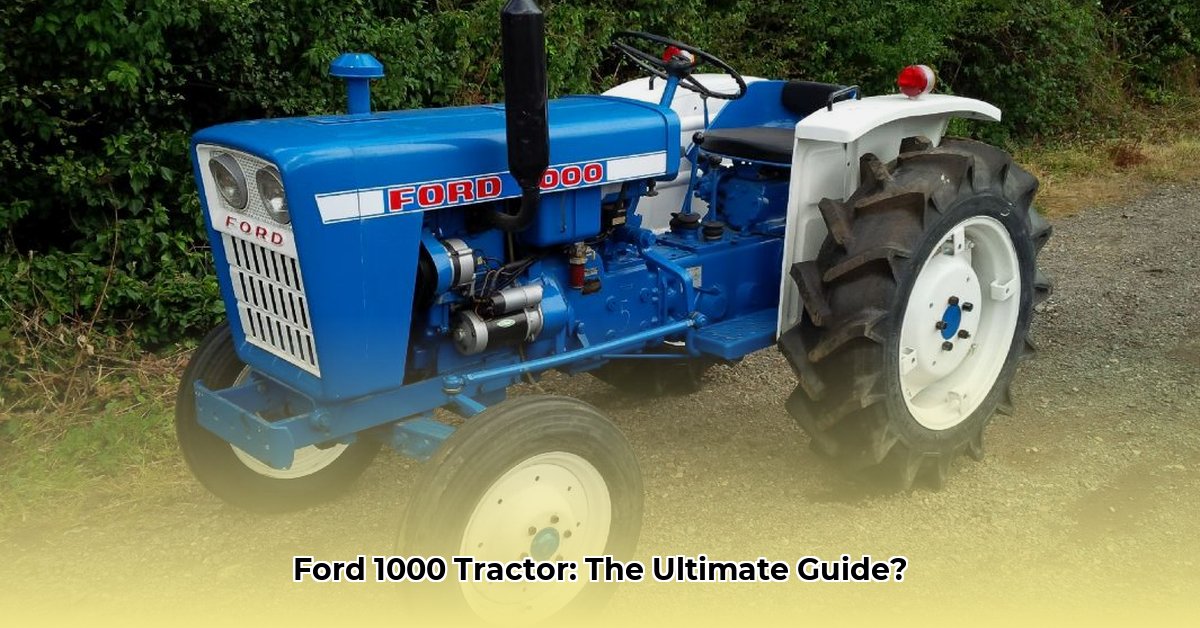
The Ford 1000 tractor, a compact workhorse produced from 1973 to 1978, holds a unique position in the vintage tractor market. Appealing to both small-scale farmers and collectors, this guide provides a comprehensive overview, including market analysis, buying advice, and maintenance tips. Whether you're looking for a reliable machine or a rewarding restoration project, the Ford 1000 offers a compelling blend of practicality and nostalgia. For more information on Ford tractors from a similar era, see this helpful resource.
Specifications and Overview
The Ford 1000 is characterized by its 25-horsepower (PTO 23 hp), two-cylinder diesel engine, known for its rugged reliability and ease of maintenance. Its compact size makes it ideal for smaller properties, while its nine-speed transmission offers versatility for a range of tasks. The two-wheel-drive system, while not suitable for heavy pulling, is sufficient for many farming applications. Its relatively short production run (1973-1978) contributes to its desirability among collectors.
| Specification | Detail | Notes |
|---|---|---|
| Engine | 2-cylinder diesel | Known for its reliability and ease of maintenance. |
| Horsepower | 25 hp (PTO 23 hp) | Sufficient power for many small-scale farming tasks. |
| Transmission | 9-speed | Offers a wide range of gears to handle various conditions. |
| Drive Type | 2WD | Suitable for most applications, but not ideal for heavy pulling. |
| Production Years | 1973-1978 | A relatively short production run, enhancing its collector value. |
Market Analysis: Understanding the Ford 1000 Landscape
The Ford 1000 enjoys consistent demand in the vintage tractor market. Online auction data reveals price ranges spanning several thousand dollars, heavily influenced by condition and hours of operation. Well-maintained examples with low hours command significantly higher prices. But what other factors are at play? Let's explore.
Is the availability of parts a major concern for potential buyers? While many common parts remain accessible, sourcing specialized components might require more effort and research. This impacts both restoration projects and ongoing maintenance costs.
Auction data, further analyzed, reveals that tractors in excellent, fully operational condition fetch prices considerably higher than those needing repairs or restoration. This underscores the importance of a thorough pre-purchase inspection.
Risk Assessment Matrix
Before purchasing, carefully consider the following:
| Risk Factor | Likelihood | Impact | Mitigation |
|---|---|---|---|
| Parts Availability | Medium | Medium | Develop relationships with vintage tractor parts suppliers. Utilize online forums. Stock common parts proactively. |
| Mechanical Failure | Medium | Medium | Regular maintenance is essential. Seek a reliable mechanic specializing in vintage tractors. |
| Resale Value Decline | Low | Low | Meticulous maintenance and thorough documentation of repairs maintain resale value. |
| Regulatory Compliance | Low | Low | Verify compliance with local regulations for vintage equipment operation and maintenance. |
Buyer's Guide: A Step-by-Step Approach to Purchase
Purchasing a used Ford 1000 requires a systematic approach. This guide details the essential steps.
1. Pre-purchase Inspection: Conduct a thorough assessment. Check the engine for unusual noises, assess transmission smoothness, inspect hydraulics, test the electrical system, examine tires for wear, and check the frame for structural faults. This step is crucial.
2. Price Negotiation: Research comparable recent sales. Auction data provides a valuable benchmark, but always negotiate respectfully. The seller's motivation will influence the final price.
3. Parts Sourcing: Familiarize yourself with established suppliers. Online forums and communities dedicated to vintage tractors are invaluable resources. Maintain a stockpile of readily-worn parts to prevent extended downtime.
4. Maintenance and Repair: Regular maintenance is vital for longevity. Learn basic maintenance or engage a qualified mechanic. Preventative measures are more cost-effective than major repairs.
Collector's Perspective: Preserving a Piece of History
The Ford 1000 possesses significant historical value for collectors. Its design represents a specific era in agricultural technology. Finding a pristine, original example requires persistence and thorough research.
Restoration requires patience and a systematic approach. Original manuals and parts catalogs are invaluable. Online resources and expert advice accelerate the process and increase the likelihood of success.
Conclusion: Weighing the Pros and Cons
The Ford 1000 tractor offers a unique combination of practicality and historical significance. While the potential challenges of parts sourcing and maintenance should be considered, the rewards of owning a reliable machine or a beautifully restored piece of history make it a worthwhile investment for the right buyer. Careful planning and diligent research are essential for a successful purchase and ownership experience.